 Why invest in Greece
 Why invest in Athens
 FAQ
FAQ Apartment Prices in Athens: 2025 Review
 Mortgage in Greece 2025: A Comprehensive Guide to Obtaining Real Estate Financing in Greece
 Golden Visa Greece: The Complete Guide to Obtaining a Golden Visa in Greece



Athens is not a city that can be understood through a single district or a single pricing trend. For international investors, the real opportunity lies in understanding how the city is laid out, how neighborhoods connect to transport and demand drivers, and how different areas support different investment strategies.
In recent years, Athens has become one of Europe’s most closely watched real estate markets. It combines relatively accessible entry prices, improving infrastructure, strong tourism appeal, and rising interest from both private and institutional buyers. But to make informed decisions, investors need more than a general view of the market. They need to understand the city’s geography and what each part of Athens can realistically offer.
Key Takeaways
- Athens offers a wide range of investment zones, from central tourist districts to luxury suburbs and regeneration areas.
- Neighborhood selection has a direct impact on rental demand, resale potential, and long-term appreciation.
- Central areas can offer strong short-term demand, but regulations and competition are more relevant there.
- Luxury suburbs tend to attract stable tenants and long-term capital preservation strategies.
- Emerging districts may offer lower entry prices and stronger upside, but they also carry more execution risk.
- Access to metro and tram lines remains one of the most important drivers of tenant demand and property performance.
- Investors should evaluate Athens not only by price per square meter, but by infrastructure, legal compliance, and local market depth.
Why an Athens Map Matters for Property Investors
A city map is not just a navigation tool. In real estate, it is a framework for risk assessment, tenant targeting, and long-term planning. Two properties with similar sizes and prices can perform very differently depending on their exact location, transport access, and neighborhood profile.
Athens is especially important to read correctly because the market is not uniform. Some areas are driven by tourism, others by local residential demand, others by students, and others by long-term urban regeneration. That diversity is one reason many foreign buyers still see buying property in Greece through an Athens-first lens.
Expert tip: A good investment map is not about identifying the cheapest neighborhoods. It is about identifying where price, demand, and future improvement intersect.
Understanding Athens by Investment Zones
For practical investment analysis, Athens can be viewed in several broad geographic categories. Each one offers a different balance between entry cost, rental profile, and appreciation potential.
The historic center
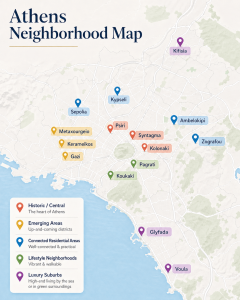
The historic and central districts include areas such as Syntagma, Psiri, and parts of the broader inner core. These neighborhoods attract tourists, short-stay visitors, and buyers who want immediate access to the city’s cultural and commercial center.
Their advantages include:
- Strong visibility and international recognition
- Easy access to major attractions, dining, and nightlife
- High demand for short-term and flexible accommodation
- Strong transport connectivity
Their challenges include:
- Higher price per square meter
- Tight competition among investors and operators
- Greater sensitivity to short-term rental regulation
For investors focused on central demand, understanding apartment prices in Athens can help set realistic expectations before targeting premium or tourism-heavy districts.
Expert tip: In central Athens, operational discipline matters as much as acquisition price. A good building, legal clarity, and a strong management plan often matter more than buying one street closer to a landmark.
Luxury suburbs
Areas such as Glyfada, Voula, and Kifisia offer a different proposition. These are more residential, higher-end markets that appeal to buyers seeking quality surroundings, stable tenant profiles, and long-term appreciation rather than purely aggressive yield.
These neighborhoods often offer:
- Higher-quality housing stock and stronger tenant profiles
- More stable long-term rental demand
- Better fit for lifestyle buyers and family-oriented tenants
- Stronger defensive characteristics in uncertain market cycles
The main trade-off is the higher entry price and, in some cases, a lower immediate cash yield compared with more opportunistic central or emerging districts.
Expert tip: Luxury districts are often better suited to investors prioritizing capital preservation, tenant stability, and long-term resale quality rather than maximum short-term yield.
Emerging neighborhoods
Districts such as Metaxourgeio, Kerameikos, and Gazi continue to attract attention because of their regeneration potential. These areas often offer lower entry prices and a stronger value-add angle, especially when buildings are renovated thoughtfully and positioned correctly.
Their strengths may include:
- Lower acquisition costs than prime central areas
- Stronger upside if regeneration continues
- Appeal to younger renters, creatives, and urban professionals
- Opportunities for repositioning older assets
Their risks may include:
- Inconsistent street quality from one block to another
- Remaining infrastructure or building-quality gaps
- Greater need for hands-on due diligence and asset management
Many investors exploring real estate opportunities in Athens are drawn to these neighborhoods because they offer a clearer path to appreciation when the asset and micro-location are chosen carefully.
Expert tip: In emerging areas, block-level analysis matters. A neighborhood may be improving overall while still containing streets that are weak for tenant demand or resale liquidity.
Transport Access and Why It Shapes Returns
One of Athens’ biggest structural advantages is its transport network. Metro lines, tram routes, airport access, and dense bus coverage all influence how attractive a property is to tenants and guests.
For investors, proximity to transport affects:
- Occupancy potential
- Tenant convenience
- Exit value
- Day-to-day management efficiency
Neighborhoods such as Ambelokipi, Zografou, and Kypseli often benefit from this dynamic because connectivity supports both local and international demand. For many investors, this is also where neighborhoods in Athens become more than a lifestyle question and turn into a performance question.
Expert tip: A property that looks attractive on price alone can become far less attractive if it depends on difficult transport access. Walkability to a metro or tram stop is often a core investment metric.
Tourism, Students, and Local Demand
Athens benefits from multiple demand streams at once. Tourism remains a major force, but it is not the only one. The city also attracts students, professionals, and long-term residents who support a broad residential rental market.
This matters because it gives investors more than one possible strategy:
- Short-term rentals in suitable central areas
- Mid-term furnished rentals for professionals and visitors
- Long-term rentals for students, workers, and local households
- Lifestyle-oriented ownership in higher-end suburbs
This diversity helps explain why Athens recovered relatively quickly after the pandemic disruption. By the time tourism rebounded strongly, the city was already supported by its broader urban economy and institutional depth.
Expert tip: The best investments are often in locations that can serve more than one tenant profile. Flexibility can improve both occupancy resilience and resale appeal.
Quality of Life Still Matters
Not every investment decision in Athens is based only on yield. Many international buyers also think about personal use, future relocation flexibility, or a hybrid strategy that combines income with lifestyle value.
Athens offers a rare combination of:
- Historic urban life
- Access to universities and cultural institutions
- Proximity to the coast
- Year-round appeal for residents and visitors
This is why some neighborhoods perform well not because they are the cheapest, but because they offer a more balanced day-to-day experience. Areas such as Pagrati and Koukaki are often appealing in this sense because they blend local life, convenience, and accessibility.
Expert tip: If a property could work both as an investment and as a place someone would genuinely enjoy living in, that usually strengthens long-term marketability.
How to Use an Athens Map Strategically
A useful Athens map should help investors answer a few practical questions before they buy:
- Is the neighborhood driven by tourism, local housing demand, or a mix of both?
- How close is the property to reliable public transport?
- Is the surrounding area mature, luxury-oriented, or still regenerating?
- What type of tenant or guest is most likely to choose that location?
- Does the property fit a yield strategy, a capital-growth strategy, or a balanced one?
These questions matter more than broad market enthusiasm. Athens continues to attract attention for good reason, but successful investing still comes down to choosing the right area, the right building, and the right operating model.
Final Thoughts
An Athens map is really a decision-making tool for investors. It helps translate the city from a broad opportunity into a set of practical, location-based strategies. Central districts, suburban luxury zones, and emerging neighborhoods can all work well, but they serve different goals and require different expectations.
The key is not simply to invest in Athens. It is to understand which part of Athens fits your budget, risk profile, and long-term plan.
Ready to Explore Opportunities in Athens?
If you are considering property investment in Athens and want help identifying the right neighborhood, Beta Real Estate can guide you through the process from location selection and due diligence to acquisition and ongoing management.
Whether you are looking for a central income-producing apartment, a regeneration opportunity, or a long-term residential asset, our team can help you approach the Athens market with greater clarity and confidence.
FAQ – Common Questions About Athens Map and Neighborhood Selection
Why is neighborhood selection so important in Athens?
It directly affects rental demand, tenant profile, resale potential, and risk.
- Different areas of Athens serve different types of demand.
- A central tourism-focused district works differently from a luxury suburb.
- Emerging areas may offer stronger upside, but they usually require more careful due diligence.
- Even small differences in micro-location can materially affect performance.
Expert tip: In Athens, “good area” is too broad to be useful. Focus on the specific street environment, transport access, and tenant demand profile.
For further reading, see Where to Invest in Athens.
Are central Athens neighborhoods always the best for investors?
No, because the best area depends on the investor’s strategy.
- Central districts may suit short-term rental or flexible-use strategies.
- Luxury suburbs may suit stability and long-term value.
- Emerging zones may fit investors looking for appreciation and repositioning potential.
- The right choice depends on budget, risk tolerance, and management capacity.
Expert tip: There is no universal “best area” in Athens. There is only the area that best fits your intended use and investment horizon.
For further reading, see Athens as a real estate gem.
How important is proximity to metro and tram stations?
It is extremely important for both rental demand and long-term liquidity.
- Transport access improves convenience for tenants and guests.
- Better-connected properties often maintain stronger occupancy.
- Good access can also support resale value over time.
- In many cases, transport quality is one of the clearest differences between similar-looking assets.
Expert tip: A slightly smaller apartment in a well-connected location can outperform a larger one in a weaker transport corridor.
For further reading, see how the Athens Metro shapes demand.
Do emerging neighborhoods in Athens offer better value?
They can, but they also involve more risk and require stronger local knowledge.
- Entry prices may be lower than in established prime areas.
- Appreciation potential can be stronger if regeneration continues.
- Building condition and street quality matter a lot.
- Execution risk is higher if the investor relies only on headline pricing.
Expert tip: In regeneration areas, buying well matters more than buying early.
For further reading, see urban renewal in central Athens.
Can foreign buyers manage Athens property remotely?
Yes, with the right local support structure in place.
- Many international investors buy and manage property from abroad.
- Legal support, property management, and maintenance coordination are essential.
- Remote ownership works best when reporting and compliance are handled professionally.
- The more operationally complex the strategy, the more important local support becomes.
Expert tip: Remote ownership is not difficult when the acquisition process and post-purchase management are set up correctly from day one.
For further reading, see common questions about investing in Greek real estate.