 Why invest in Greece
 Why invest in Athens
 FAQ
FAQ Apartment Prices in Athens: 2025 Review
 Mortgage in Greece 2025: A Comprehensive Guide to Obtaining Real Estate Financing in Greece
 Golden Visa Greece: The Complete Guide to Obtaining a Golden Visa in Greece

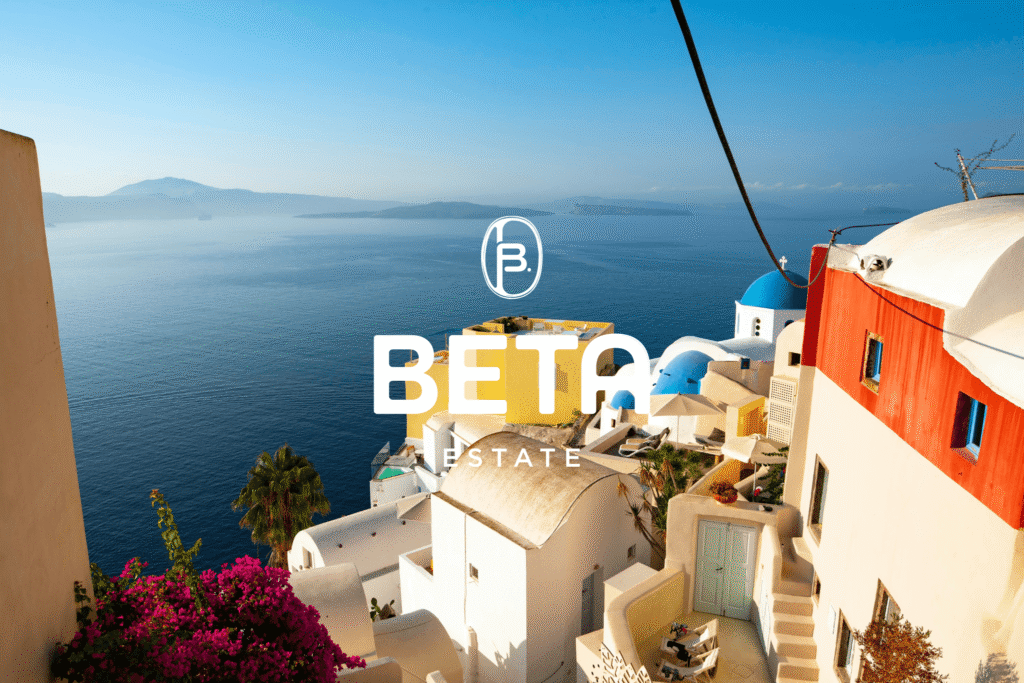


Real estate investment in Greece is far more than simply purchasing an apartment in Southern Europe. For many international investors, it is an opportunity to enter a recovering market with relatively accessible entry prices, strong rental demand, and meaningful long-term upside. At Beta Real Estate, we work daily with buyers who understand what the headlines are only beginning to reflect: Greece has become a smart, accessible, and increasingly strategic place to invest in property.
Key Takeaways
Greece offers a rare combination of affordability, legal clarity, rental demand, and long-term appreciation potential.
Main takeaways include:
- In some cases, properties are still trading significantly below pre-crisis levels.
- Greece offers investor-friendly conditions, including relatively low purchase tax and capital gains tax exemptions in certain cases.
- Buyers invest in a euro-based market within the European Union.
- Full freehold ownership is generally available and registered in the Land Registry.
- The mortgage market is gradually reopening, which may support future price growth.
- The country combines tourism, urban demand, infrastructure, and international appeal.
- Investors can choose between Athens, Piraeus, selected islands, and other regional opportunities depending on strategy.
- With the right local guidance, Greece can offer both income generation and long-term capital appreciation.
1. The Aftermath of the Economic Crisis Still Creates Opportunity
One of the main reasons investors continue to look at Greece is the market reset created by the 2008 financial crisis. According to the source text, the crisis pushed property prices down sharply, and in some cases assets can still be purchased at levels far below former peak values.
That matters because recovery markets often offer something mature markets do not: room to appreciate from a lower base. Investors entering at this stage may benefit from continued normalization in pricing as the economy and financing environment improve.
This does not mean every property is automatically a bargain. But it does mean Greece still offers pricing dynamics that are increasingly rare elsewhere in Europe.
Expert tip: A recovering market is attractive only when recovery is supported by real demand, not just optimism. In Greece, tourism, housing demand, and improving macro conditions all help support that recovery story.
2. Government Policy Remains Supportive of Foreign Investment
Greece has actively positioned itself as a country that welcomes foreign property investment. The source article highlights several advantages, including:
- Purchase tax of around 3.09%
- Capital gains tax exemption in certain cases
- A relatively clear purchase process
- Bank account opening options for foreign investors
- Broader government efforts to attract international capital and companies
For international buyers, this matters because legal simplicity and predictability can be just as important as headline prices. Markets that combine accessible entry with workable legal structures tend to remain attractive over time.
Understanding the full cost of buying real estate in Greece is an important part of evaluating how supportive the framework really is in practice.
Expert tip: Tax and acquisition structure should be part of your strategy from day one. In cross-border real estate, how you buy can affect your return almost as much as what you buy.
3. Greece Offers Access to a Stable European Market
Greece is a full member of the European Union and operates in the euro. For international buyers, that creates a very different profile from investing in a smaller or less integrated regional market. The source article emphasizes the importance of this EU framework, the euro-based economy, and the transparency of registered ownership.
For many buyers, this adds a sense of legal and economic familiarity that can reduce perceived investment risk – especially when compared with non-EU jurisdictions or markets with less transparent land systems.
Expert tip: Stability in real estate is not only about the property – it is also about the currency, legal system, and institutional environment surrounding the investment.
4. Full Freehold Ownership Gives Buyers Legal Clarity
A major advantage in Greece is that properties are generally registered under the buyer’s name in the Land Registry, with full freehold ownership. The source text emphasizes that this gives investors strong legal control and flexibility to sell, rent, or pass the property on in the future.
This is especially relevant for foreign buyers who want to avoid complicated leasehold structures, hidden third-party rights, or unclear title arrangements.
That said, legal due diligence remains essential. Even in a clear ownership system, a buyer still needs to verify title, debts, building legality, and registration accuracy before signing.
This is one reason the full guide to buying an apartment in Greece is such an important companion resource for serious buyers.
Expert tip: Freehold ownership is only valuable when the title is clean. In Greece, a strong lawyer is one of the most important parts of the investment process.
5. Greece Combines Rental Demand with Long-Term Appreciation Potential
Greece is attractive not only because of current pricing, but because of what supports future value: demand. While the article focuses heavily on Athens, the broader point applies nationally in many investment zones – rental demand is supported by tourism, local residents, students, and professionals.
For investors, that creates a stronger overall case because the property can work in more than one way:
- It may generate rental income
- It may appreciate as the market matures
- It may serve personal or mixed-use goals
- It may offer optionality for resale or repositioning later
Understanding rental income potential in Athens helps show how this plays out at the property level.
Expert tip: The strongest investment markets are usually the ones where income and appreciation can reinforce one another, rather than forcing the investor to choose only one.
6. The Mortgage Market Is Gradually Reopening
The source article notes that Greece’s mortgage market, which was largely frozen after the crisis, is beginning to show signs of reopening. Local residents are increasingly receiving mortgages, and banks are cautiously exploring financing options for foreign investors as well.
This matters because mortgage availability can change a market’s trajectory. As financing becomes more accessible, demand can increase and price pressure can accelerate.
Many investors prefer to enter the market before that shift becomes fully reflected in values. Buyers who are evaluating leverage should understand the current mortgage landscape in Greece.
Expert tip: When financing begins returning to a recovering market, the biggest gains are often made by investors who entered before leverage became widely available again.
7. The Greek Economy Is Showing Clear Signs of Stabilization
The source article points to multiple indicators suggesting that Greece’s economy is on firmer footing than in the past, including reduced unemployment, pro-business policy, stable political leadership, and a broader recovery in key sectors such as tourism, shipping, and industry.
For real estate investors, macroeconomic stabilization matters because it affects:
- Consumer confidence
- Local housing demand
- Employment and rent affordability
- Bank behavior
- Long-term investor sentiment
That broader Greek real estate market and economy context is an important reason many investors now view Greece differently than they did a decade ago.
Expert tip: Real estate is easiest to buy when a market still carries old perceptions – but fundamentals are already improving underneath them.
8. Greece Offers More Than One Investment Story
Although Athens often leads the conversation, Greece is not a one-market story. Investors can look at several different profiles depending on strategy:
- Athens for urban rental demand and regeneration
- Piraeus for infrastructure-led upside
- Islands for tourism-driven property
- Emerging neighborhoods for value-add potential
- Residential zones for stable local demand
This flexibility allows investors to match property choices to their real goal rather than forcing every strategy into the same city-center template.
For those focused on the capital, Athens remains one of the most attractive real estate destinations in Europe.
Expert tip: The right market is not always the most famous one. The best investment often comes from choosing the submarket that matches your exact time horizon and risk profile.
9. The Window of Opportunity Is Still Open – But Not Forever
The source text concludes with a simple idea: Greece still offers a rare entry point because prices remain relatively controlled, quality supply is still available, and many buyers are waiting for the market to feel even more established before acting.
But that waiting can come at a cost.
As market confidence improves, financing gradually returns, and more international investors enter, strong assets tend to become harder to find at attractive prices. Investors who move early often benefit from both lower acquisition costs and wider choice.
Expert tip: Good markets rarely stay underpriced once they become universally recognized. The advantage often belongs to the investors who act while the opportunity is visible – but not yet crowded.
Final Thoughts
Investing in Greece in 2026 and beyond is compelling not because it is fashionable, but because the fundamentals remain supportive: accessible pricing, euro-based stability, rental demand, legal ownership clarity, and a market that continues to normalize after a deep reset. The source article frames Greece as a market where investors can still enter at a favorable stage while broader momentum is already underway.
For international investors, the real opportunity lies in combining this market timing with the right strategy, the right property, and the right local execution.
FAQ – Common Questions About Investing in Greece
What taxes apply when purchasing property in Greece?
Buyers should usually expect purchase tax plus legal, notary, and registration costs on top of the purchase price.
- The source article lists purchase tax at 3.09%.
- Legal fees are often around 1% to 1.5%.
- Notary and registration fees are often around 2.5%.
- Total transaction costs are commonly estimated at roughly 6% to 7.5%, depending on the deal.
Expert tip: Always budget based on total acquisition cost, not just the property price. In Greece, the “real price” of a purchase is always higher than the listing number.
For further reading, see Costs to Consider Before Purchasing Real Estate in Greece (2026).
Can foreign investors obtain a mortgage in Greece?
Yes – but options remain limited and more selective than in many home markets.
- Most foreign buyers still purchase without Greek financing.
- Some banks are gradually exploring mortgage solutions for non-residents.
- Lending conditions depend heavily on borrower profile, documentation, and the property.
- Financing should be examined early in the process rather than assumed.
Expert tip: In Greece, financing is a strategic bonus, not something every investor should automatically rely on.
For further reading, see Mortgages in Greece 2026: A Comprehensive Guide to Real-Estate Financing.
Is it easy to sell the property in the future?
Yes – in most standard cases, a properly registered freehold property can be sold relatively freely.
- Registration in the Land Registry supports resale flexibility.
- Many investors target both income and future resale upside.
- Actual resale performance depends on area, market timing, and property quality.
- Liquidity is usually strongest for well-located, legally clean assets.
Expert tip: The best resale strategy starts at the purchase stage. Buy the type of asset future buyers will also want.
For further reading, see What You Really Need to Know: 20 Key Questions About Investing in Greek Real Estate.
Should I manage rentals myself or work with a local company?
For most non-resident investors, working with a local management company is usually the more practical option.
- Local management helps with tenant communication, repairs, collection, and oversight.
- It becomes especially important for short-term rental operations.
- Even long-term rentals benefit from local responsiveness and legal familiarity.
- Self-management from abroad often becomes more time-consuming than expected.
Expert tip: Overseas real estate becomes much easier when management is treated as part of the investment model, not as an afterthought.
For further reading, see How Much Can You Earn from Rental Income in Athens?.
Does legal support really matter that much?
Yes – legal support is one of the most important parts of a safe purchase in Greece.
- Title checks can reveal ownership or debt issues.
- Legal review helps confirm the property can be transferred cleanly.
- Tax registration, contracts, and powers of attorney often require local legal coordination.
- A good lawyer can prevent extremely costly mistakes before signing.
Expert tip: The cheapest lawyer can become the most expensive part of the deal if something goes wrong.
For further reading, see The Complete Guide to Buying an Apartment in Greece: Everything You Need to Know [2026].
Do I need a Greek bank account to buy property?
Not always – but in many cases it makes the process smoother.
- Some payments can be handled through a lawyer or representative.
- A local account can simplify taxes, utilities, and ongoing ownership costs.
- It may also be important if financing is part of the strategy.
- The practical need depends on the structure of the transaction and post-purchase plan.
Expert tip: A Greek bank account is often more about convenience and control than legal necessity – but that convenience can matter a lot over time.
For further reading, see The Complete Guide to Buying an Apartment in Greece: Everything You Need to Know [2026].
Is Greece suitable for first-time overseas investors?
Yes – many buyers enter Greece as their first international property market.
- The market can be accessible compared with other European destinations.
- Full ownership rights and euro-based pricing help make the structure easier to understand.
- Good guidance is especially valuable for first-time overseas buyers.
- Starting with one carefully chosen property is often a smart first move.
Expert tip: First-time overseas investing works best when the market is understandable, the numbers are clear, and the local team is strong.
For further reading, see Real Estate Investments Abroad – What Drives Investors to Invest in Overseas Real Estate?.
How do I know if a property is truly a good investment?
A good investment is one that works on location, legal clarity, pricing, demand, and execution – not just appearance.
- Market analysis and transaction comparisons matter.
- Rental demand should be verified, not assumed.
- Building condition and legal status should be checked in advance.
- The strategy behind the purchase should be clear before committing.
Expert tip: A beautiful property is not always a good investment. In Greece, the numbers, the documents, and the street matter more than the listing photos.
For further reading, see 8 Common Real Estate Investment Mistakes in Greece – and How to Avoid Them (2026).
Ready to Explore Opportunities in Greece?
If you are considering Greece as your next real estate market, Beta Real Estate can help you understand where the strongest opportunities are – based on your goals, budget, and investment strategy.
We work with international buyers looking for income-producing properties, long-term upside, and practical guidance on how to invest in Greece with confidence.
Get in touch with us to explore the right next step for your investment in Greece.