 Why invest in Greece
 Why invest in Athens
 FAQ
FAQ Apartment Prices in Athens: 2025 Review
 Mortgage in Greece 2025: A Comprehensive Guide to Obtaining Real Estate Financing in Greece
 Golden Visa Greece: The Complete Guide to Obtaining a Golden Visa in Greece



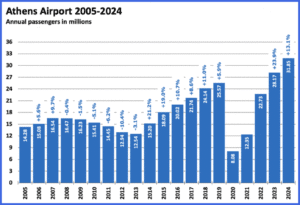
Source: Athens Airport
Athens Is Becoming a Standalone Hospitality Story
Athens is no longer just the place travellers pass through before heading to the islands. It is increasingly a destination in its own right, supported by culture, city-break demand, premium coastal development, and expanding air connectivity.
Athens International Airport’s record 33.99 million passengers in 2025, followed by another strong start in 2026, reinforces that point. International traffic has been the main growth driver, which is especially relevant for investors focused on demand backed by foreign spending.
That same trend helps explain why many international buyers continue to focus on real estate opportunities in Athens rather than treating the city as a secondary market. The hospitality story and the property story increasingly support each other.
Expert tip: In markets like Athens, strong tourism performance matters most when it starts feeding year-round occupancy, business travel, and urban regeneration, not just seasonal spikes.
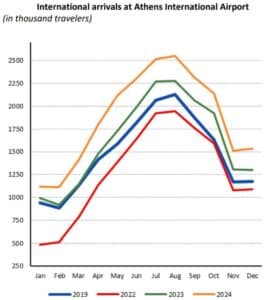
Source: Bank Of Greece
Luxury Hospitality Still Leads the Investment Narrative
The premium segment remains one of the clearest expressions of investor confidence in Greece. International brands and higher-end operators continue to expand because they see Greece as capable of attracting affluent travellers, longer stays, and experience-driven demand.
Industry reporting in 2026 continues to show that the Greek hotel market is becoming more sophisticated, with stronger revenue management, broader brand presence, and continued focus on upscale product. At the same time, the wider pipeline of hotel and tourism infrastructure investment remains substantial, particularly in Athens, the Riviera, resort destinations, and selected emerging islands.
This premium tilt does not mean the whole market is luxury-led. It does mean that the direction of travel is clearly toward higher-value hospitality, better assets, and more selective positioning.
That is also relevant when investors assess apartment prices in Athens, because hospitality-led upgrading in certain districts can influence both residential demand and pricing expectations.
Expert tip: Luxury growth is not only about five-star hotels. It often reshapes nearby neighborhoods, raises service expectations, and lifts the perceived value of surrounding real estate.
Hotel Demand Is Strong, but Competition Is More Complex
A positive market does not mean an easy one. One of the clearest messages from recent hotel data is that Greece is growing while also becoming more competitive.
The 2025 hotellab report noted that booking activity increased, but cancellations rose faster, especially during the summer period. That is a sign of a market where consumer behavior is more dynamic and operators need stronger pricing, distribution, and forecasting tools.
At the same time, the short-term rental market remains a major competitive force. Greece’s tax authority continues to operate a formal short-term rental registry and reporting system, while the Ministry of Tourism confirmed that Law 5170/2025 came into force on October 1, 2025. The ministry also stated that for both 2025 and 2026 no new short-term rental registry entries would be allowed in the 1st, 2nd, and 3rd municipal districts of Athens.
For investors, this is important on two levels. First, it shows the state is taking housing pressure and tourism balance more seriously. Second, it means regulatory quality now matters much more in underwriting hospitality-related real estate.
That is why anyone evaluating future rental income in Athens should look not only at demand, but also at licensing rules, local competition, and operating compliance.
Expert tip: In regulated urban markets, projected yield is only meaningful if the operating model is still realistic under current and likely future rules.
Sustainability and Season Extension Are Now Core Strategy
Greece has been talking for years about moving beyond the classic summer-only model. In 2026, that is less of a slogan and more of a practical necessity.
The Ministry of Tourism continues to frame quality, balance, and upgraded tourism supply as policy priorities, while the wider sector is under pressure to deal with climate exposure, infrastructure strain, and uneven seasonality. Meanwhile, the Climate Crisis Resilience Fee remains in place and is administered through the tax system, reflecting how environmental resilience is now part of the cost structure of hospitality in Greece.
For the sector, this creates both pressure and opportunity. Markets that can attract visitors in spring, autumn, and winter are likely to enjoy better staff retention, more stable revenue patterns, and less dependence on peak-season extremes.
Expert tip: The strongest hospitality markets are increasingly the ones that can generate twelve-month relevance, not just a strong August.
Technology and Operations Matter More Than Before
Technology adoption is no longer limited to a few flagship hotels. Across the market, revenue management, forecasting tools, digital guest services, and more efficient operating systems are becoming standard competitive requirements.
Recent sector reporting highlights that Greece’s hotel performance is increasingly shaped by pricing systems, demand forecasting, and booking-channel management rather than simple room supply expansion.
This is especially relevant in a market where labor shortages remain severe. The challenge has not disappeared. Greece still faces structural staffing pressure in tourism and hospitality, which affects service quality, operating consistency, and expansion capacity. While state measures and cross-border labor arrangements have attempted to ease the problem, labor remains one of the sector’s key bottlenecks.
Expert tip: In hospitality assets, operational quality often determines returns as much as location does. A good property with weak execution can underperform a less glamorous asset with strong management.
What This Means for International Investors
The Greek hospitality story in 2026 is attractive, but it is no longer a simple growth story. It is a market that rewards selectivity.
Investors should think in terms of:
- destination strength
- year-round demand potential
- regulatory clarity
- local operating capability
- asset positioning within a more premium, more disciplined market
For some, that means direct hotel exposure. For others, it means residential or mixed-use strategies in locations supported by tourism, infrastructure, and urban demand. In either case, the hospitality sector remains one of the clearest indicators of where international confidence in Greece is strengthening.
Final Thoughts
Greece’s hospitality market entered 2026 with strong momentum, but the more important point is that it is becoming more structured and more investment-grade. Record tourism performance, stronger hotel pricing, continued strength in Athens, and more active regulation of short-term rentals all point to a market that is evolving rather than overheating.
For international investors, that creates a better framework for decision-making. The opportunity in Greece is still real, but the best results are likely to come from disciplined asset selection, careful compliance, and a clear understanding of how hospitality trends affect wider real estate value.
Ready to Explore Opportunities in Greece?
If you are looking at hospitality-driven property demand, urban regeneration, or income-focused real estate in Athens and other high-interest Greek markets, Beta Real Estate can help you assess the opportunity with local insight and investor-focused guidance.
From market selection to acquisition strategy, we work with international buyers who want a clearer view of how tourism trends, regulation, and real estate fundamentals come together in Greece.
FAQ – Common Questions About Hospitality in Greece
Is Greece still a strong hospitality market in 2026?
Yes, Greece remains one of Europe’s stronger hospitality markets, supported by record recent tourism data and continued growth in hotel and airport indicators.
- 2024 set new highs for travel receipts and inbound travellers.
- Hotel performance in 2025 improved on ADR, occupancy, and RevPAR.
- Athens airport traffic remained strong in both 2025 and early 2026.
- The market is moving toward higher-value, better-managed tourism rather than simple volume alone.
Expert tip: The most attractive hospitality markets are often the ones moving from cyclical recovery into more disciplined long-term growth.
For further reading, see 9 compelling reasons to invest in Greece.
Why is Athens so important to the hospitality story?
Athens now combines tourism demand, city-break appeal, business travel, and coastal development in a way that supports year-round activity.
- It is no longer seen only as a transit point to the islands.
- Airport traffic growth supports the city’s role as an international gateway.
- Urban regeneration and premium hospitality projects have raised the city’s profile.
- The local property market increasingly benefits from that broader momentum.
Expert tip: A city becomes especially interesting for investors when tourism growth starts aligning with business activity, infrastructure upgrades, and residential demand.
For further reading, see Why invest in Athens.
Are short-term rental rules becoming stricter in Greece?
Yes, Greece is clearly moving toward tighter regulation, especially in pressure zones.
- Registration and reporting remain central to the short-term rental framework.
- New legislation took effect in late 2025.
- In central Athens, the government has blocked new registry entries in specific districts for 2025 and 2026.
- Compliance is becoming more important for investors underwriting income-based strategies.
Expert tip: Regulation does not necessarily remove opportunity, but it does make informal or poorly planned strategies much riskier.
For further reading, see short-term rental investments in Athens.
Is Greece mainly a luxury hospitality market now?
No, but the premium and upper-upscale segments are clearly shaping the direction of the market.
- International brands continue to show confidence in Greece.
- Revenue growth has been supported by pricing strength.
- Premium positioning helps Greece attract higher-spending guests.
- Mid-market and alternative accommodation still matter, but quality differentiation is becoming more important.
Expert tip: Investors do not need to buy luxury assets to benefit from premium market trends, but they do need to understand how those trends influence surrounding demand and valuations.
For further reading, see Athens as a European real estate gem.
How does hospitality growth affect real estate investors?
Hospitality growth can support rental demand, urban renewal, and property values, especially in locations with strong international visibility.
- More visitors can mean stronger short-term and medium-term accommodation demand.
- Better infrastructure often improves accessibility and investment appeal.
- Upgraded hospitality can enhance the image of entire districts.
- Investors still need to separate headline tourism growth from realistic, regulation-aware returns.
Expert tip: Tourism growth is most valuable when it is translated into sustainable demand, not just seasonal excitement.
For further reading, see Greece’s real estate market and economy.