 Why invest in Greece
 Why invest in Athens
 FAQ
FAQ Apartment Prices in Athens: 2025 Review
 Mortgage in Greece 2025: A Comprehensive Guide to Obtaining Real Estate Financing in Greece
 Golden Visa Greece: The Complete Guide to Obtaining a Golden Visa in Greece


When we accompany investors in purchasing an apartment in Greece, the first question they almost always ask us is: “How much will I really earn from this?”
It’s an excellent question — because in real estate, especially in an evolving market like Greece, profitability is not just about numbers. It lies in timing, area analysis, understanding local taxation, and above all, in finding the right balance between capital appreciation and ongoing rental yield.
2025 is a year of balance: prices are rising, but moderately; the market is stable, yet undergoing internal shifts. Below is everything you need to know — with depth, context, and professional guidance.
Key Takeaways
-
Apartment prices continue to rise: An average increase of 6.8% across Greece in 2025, according to the Bank of Greece. In central Athens, several neighborhoods recorded increases of around 12%.
-
New-build apartments are leading the trend: Prices for new properties rose by 8.0%, compared to 6.0% for older apartments.
-
Regional disparities:
-
Athens: +5.5%
-
Thessaloniki: +10%
-
Peripheral regions: +8%
-
-
A stabilizing market: Slight slowdown compared to 2024 (8.9%) and 2023 (13.9%), yet still firmly in a growth phase.
-
Forecasted average annual growth of 3.2% through 2029, according to Knight Frank and JLL.
-
Ongoing rental yields:
-
5.5%–7.5% gross
-
4%–5.5% net, depending on the rental strategy.
-
-
Low transfer tax and capital gains tax freeze until the end of 2025 — a clear advantage for foreign investors.
-
Potential future regulation of Airbnb, particularly in high-tourism areas.
What Is the Average Price of an Apartment in Greece?
After several years of sharp price increases in Greece’s major cities — particularly Athens and Thessaloniki — 2025 continues the positive trend, albeit at a more moderate pace.
Average apartment prices are rising by approximately 5%–8%, depending on the region and property type, reflecting a healthier and more balanced market environment.
| City / Area | Typical Purchase Price (70 sqm apartment) | Average Monthly Rent (€) | Notes |
| Athens | €100,000–€250,000 | €1,500–€3,600 | Strong urban demand, central locations, high rental liquidity |
| Thessaloniki | €90,000–€150,000 | €1,300–€2,500 | Student-driven demand, young population, urban renewal |
| Piraeus / Other Major Cities | €70,000–€120,000 | €1,000–€1,800 | Growing port activity, infrastructure upgrades |
| Secondary Cities | Similar to Athens outskirts | €1,200–€2,000 | Cities such as Larissa, Patras, Volos — rising demand |
| Tourist Islands | From €5,000 per sqm | €5,000–€8,000 | High-end locations (Santorini, Mykonos, Corfu), luxury demand |
Important note: The figures above refer to non-new / non-fully renovated properties.
What’s Driving These Trends? A Combination of Key Factors
-
Stable tourism at record levels: In 2024, Greece welcomed over 33 million tourists, reaching new all-time highs.
-
Improving local economy: Unemployment has dropped significantly (to around 10% today, compared to 27% in 2013), alongside continued GDP growth of over 2% annually.
-
Strong foreign demand: Buyers from across Europe and North America are actively investing, taking advantage of Greece’s relative affordability and favorable euro exchange dynamics.
Important to remember:
Unlike purely seasonal tourist destinations, Athens benefits from consistent, year-round demand. Students, local residents, business professionals, and diplomats create a continuous flow of tenants, providing investors with a stable safety net and reduced seasonality risk.
| City / Area | Estimated Gross Rental Yield | Estimated Annual Price Growth (2025) |
| Athens | כ־5.5% | 5%–6% |
| Thessaloniki | כ־10% | 6%–7% |
| Piraeus / Other Major Cities | כ־8.0% | 6%–8% |
| Secondary Cities | כ־7.3% | 5.5%–6.5% |
| Tourist Islands | כ־8.0% | 7%–9% |
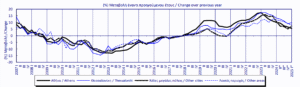
Apartment Rental Yields in Greece – Source: Bank of Greece
On-the-ground tip:
A property rented on a long-term basis to students in Athens typically delivers slightly lower returns, but with near-zero risk. Neighborhoods such as Zografou, Ilisia, and Ambelokipi are particularly recommended.
Apartment Rental Yields in Greece: Long-Term vs. Short-Term / Holiday / Airbnb Rentals
One of the key considerations for investors purchasing an apartment in Greece is the rental model: long-term leasing versus short-term rentals (Airbnb).
The differences between these models go beyond yield alone — they also affect risk levels, required involvement, and regulatory exposure.
-
Short-term rentals offer higher profit potential but require active management, ongoing maintenance, and competitiveness in a crowded market.
-
Long-term rentals generate lower returns, but provide stable, predictable income, along with operational peace of mind and greater regulatory certainty.
Comparison Between the Two Models
| Rental Model | Estimated Gross Yield | Estimated Net Yield | Key Advantages | Key Disadvantages |
|---|---|---|---|---|
| Long-Term Rental (Annual) | 6%–5% | 5%–3.5% | Stable income, regulatory certainty, low risk | Lower returns, less flexibility |
| Short-Term / Airbnb | 9%–6.5% | 6.5%–4.5% | Higher returns, flexible pricing, strong tourist demand | Requires active management, higher volatility, regulatory exposure |
On-the-Ground Tip
Renting to students in neighborhoods such as Zografou, Ilisia, and Ambelokipi contributes to operational peace of mind and high year-round occupancy.
The Greek Real Estate Market – Q1 2025 Snapshot
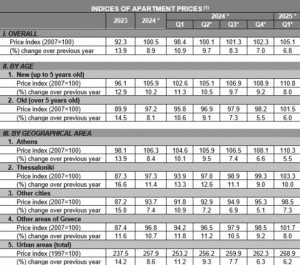
In early June 2025, the Bank of Greece published preliminary data from the Housing Price Index, reflecting a continued rise in residential property values:
-
Year-over-year (YoY) apartment prices across Greece increased by 6.8% in Q1 2025.
-
By property type:
-
New apartments (up to 5 years old) surged by 8.0% YoY
-
Older apartments (over 5 years) rose by 6.0% YoY, continuing the market’s preference for newer assets
-
-
Geographic breakdown:
-
Athens: +5.5%
-
Thessaloniki: +10.0%
-
Other cities: +7.3%
-
Peripheral regions: +8.0% YoY
-
-
Moderate slowdown vs. 2024: Prices rose 8.9% in 2024, following a rapid 13.9% increase in 2023
-
Across urban areas overall, prices increased 6.2% in Q1 2025, compared to 8.6% in 2024
Beta Real Estate – Key Conclusions
Price increases are continuing, but at a more moderate, gradual, and healthy pace.
The Greek market has transitioned from the post-2023 surge into a more balanced model, combining stability with attractive return potential.
Major cities continue to lead, while peripheral regions are gaining momentum, creating opportunities for dual-focused strategies that combine urban cores with emerging areas.
Regional Price Gaps Across Greece
Regional differentiation in Greece is significant:
-
Athens maintains its position as a stable investment destination, with average price increases of 5%–6% in 2025.
-
Thessaloniki, the country’s second-largest city, has been booming in recent years, showing faster growth of 8%–12% annually.
Athens remains a preferred destination for foreign investors due to its combination of:
-
Extensive services
-
Operational ease
-
Access to banking and high-quality legal advisory
-
Professional property management infrastructure that simplifies the investment process
Key demand drivers include:
-
Universities and educational institutions attracting students nationwide
-
Tourism concentrated in the city
-
Still-relatively affordable entry prices for new investors
Even smaller cities such as Larissa, Patras, and Volos are seeing early signs of demand, particularly from investors seeking lower entry prices with solid yields.
On-the-ground tip:
We increasingly see clients splitting their investment — one apartment in Athens and a second in a developing area such as Thessaloniki or Crete — to balance yield and stability.
Price per Square Meter – Apartments in Greece
-
In Athens, a 70 sqm apartment in central areas such as Kolonaki or Pangrati may cost €150,000–€250,000.
-
In emerging neighborhoods like Sepolia or Ilisia, prices still range around €90,000–€140,000.
On tourist islands — especially Corfu, Santorini, and Mykonos — prices per sqm can exceed €5,000, but these are highly demanding markets, with stricter regulation and higher maintenance costs.
Key factors influencing price per sqm:
-
Proximity to metro / public transport
-
Property condition (new vs. old)
-
Proximity to tourist hubs or universities
-
Inclusion in government-led urban renewal programs
On-the-ground tip:
Properties with strategic renovation planning can generate 15%–20% capital appreciation within 1–2 years, particularly when upgraded for short-term rental use.
Greek Real Estate Market – Forward Outlook
According to international advisory firms Knight Frank and JLL, the Greek real estate market is expected to grow at an average annual rate of approximately 3.2% through 2029.
After a turbulent decade, the market has stabilized and is now attracting increased attention from real estate funds, developers, and international corporations.
Remaining challenges:
-
Limited supply of new apartments
-
Uneven infrastructure development between cities
-
Tightening regulation in the short-term rental sector
Still, as an EU country with a strong currency (euro), relatively low costs, and high quality of life, Greece is becoming a stable investment alternative within a volatile European landscape.
Investing in a small town or remote island instead of Athens is comparable to choosing a secondary city over the country’s main economic hub. Athens, like other capital cities, benefits from:
-
Year-round tourism
-
Continuous infrastructure investment
-
International services
-
Strong demand from students, diplomats, families, and professionals
On-the-ground tip:
Investing today in a strategically located property in Athens, with professional management, can generate not only solid returns but also future optionality — including eligibility for the Golden Visa or a profitable exit to a foreign investor.
Financing, Regulation, and Taxation
-
Average mortgage interest rates in Greece are around 3.8%, and financing is available to foreigners (with a more bureaucratic process).
-
Very low transfer tax: only 3.09%.
-
Capital gains tax is currently frozen until the end of 2025.
-
Double-taxation treaties prevent paying tax twice on the same income.
-
Regulation: Local authorities in high-density areas are examining reforms to limit short-term rentals (e.g., caps on the number of units per investor). While there are no uniform nationwide restrictions yet, additional regulation is expected within the next two years.
On-the-ground tip:
Investors holding multiple apartments in the same neighborhood may face future regulatory pressure. Geographic and rental-model diversification is therefore advisable.
Summary
Greece in 2025 is not just a yield destination — it is a complex, dynamic real estate arena. The market continues to grow at a healthy pace, not in bubble-like exuberance, but in a way that provides confidence to patient, well-informed investors.
Q1 data points to moderate price increases, a clear preference for newer assets, and renewed foreign investor interest — recognizing Greece as a stable alternative within Europe.
Athens, in particular, offers a rare balance of stability, liquidity, and yield — exactly what a prudent investor seeks. The difference is between buying in a place that might grow, and investing in a city that is already moving forward, with room to go further.
Tourism is at record levels, the local economy is stabilizing, and the banking system is increasingly accessible to non-resident investors. At the same time, short-term rental regulation signals a clear message: the future belongs to those who plan, diversify, and act responsibly.
Investors who look beyond spreadsheets — who analyze neighborhoods, understand tenant demand, leverage financial tools, and plan with a multi-year horizon — will find in Greece a winning combination of yield, stability, value-add opportunities, and sometimes even family-level wealth structuring via Golden Visa or legacy assets.
At Beta Real Estate, we accompany you at every stage — from strategic analysis to closing, from renovation to ongoing management — turning Greece from an exotic destination into a performing investment portfolio.
Frequently Asked Questions (FAQ)
Is the Greek real estate market still profitable?
Yes — with strategic planning. Returns exist, but depend on location, asset type, and proper management.
How much can you really earn?
Net yields typically range 3.5%–5%. In specific cases — after renovation or via short-term rentals — 7%–9% is achievable.
Is it better to invest in a city or on an island?
For stability: Athens or Thessaloniki.
For higher risk–reward: islands or rural areas — but with tighter management.
Can foreigners buy property in Greece?
Yes. Foreigners can freely purchase property and benefit from relatively favorable taxation.
Why work with Beta Real Estate?
We are not just brokers. We support investors from initial selection and legal checks through renovation and post-purchase management. Over 200 investors have already been guided by our team.
Can non-citizens obtain a mortgage in Greece?
Yes, though the process is more complex and usually requires 40%–50% equity and slightly higher interest rates. We work with local banking partners experienced with foreign buyers.
Is it necessary to travel to Greece to complete a purchase?
Not necessarily. Much of the process can be completed via power of attorney, though we recommend at least one visit to see the asset and meet the team.
What is the main risk when investing in Greece?
Buying in the wrong area or without understanding local regulation — especially for short-term rentals. Professional guidance is essential.
Can renovation significantly increase returns?
Absolutely. Smart renovations — such as converting one apartment into two studios — can materially boost yields. Beta offers full planning, renovation, and management services.
Is Greece suitable for first-time investors?
Yes — provided there is professional guidance. Many of our clients are first-time buyers attracted by lower entry prices, reasonable yields, and an accessible operating model.