 Why invest in Greece
 Why invest in Athens
 FAQ
FAQ Apartment Prices in Athens: 2025 Review
 Mortgage in Greece 2025: A Comprehensive Guide to Obtaining Real Estate Financing in Greece
 Golden Visa Greece: The Complete Guide to Obtaining a Golden Visa in Greece



The Greek real estate market has undergone a dramatic transformation over the past decade. Following the severe economic crisis, which led to a 42% decline in residential property prices between 2009 and 2017, the market has entered an impressive recovery phase.
The numbers speak for themselves: nationwide prices have risen by 66%, and by 85% in the Athens metropolitan area by 2024.
What is particularly noteworthy is that Athens has already surpassed its 2008 peak by 2.4%, while the national market as a whole remains approximately 4% below its historical high.
As Beta Real Estate, active in the market since 2018 and accompanying thousands of Israeli investors, we witness this ongoing transformation firsthand. The following overview is based on official data combined with our extensive on-the-ground experience.
The State of the Greek Economy – Key Data and Trends for 2025
The Greek economy continues to show clear signs of recovery, albeit at a moderate pace. GDP is growing at approximately 2% annually, unemployment has declined from 27% at the peak of the crisis to 9.8% today, and tourism has reached record levels, with 36 million visitors in 2024.
The Four Key Drivers of the Economy
Tourism continues to be the backbone of the Greek economy, generating €21.7 billion in revenues, representing approximately one quarter of GDP. The main source markets are Germany, the United Kingdom, and France, with Israel contributing around 600,000 tourists annually.
Foreign direct investment surged by 28.9% in 2024, with the majority directed toward real estate. Chinese investors lead the market, accounting for 62% of Golden Visa holders, followed by Turkish investors (8%), Russians (5%), and Israelis (4%).
The Ellinikon Project, the largest investment in modern Greek history at €8 billion, is already delivering tangible results. By August 2024, properties worth €800 million had been sold, and the project is reshaping the landscape of southern Athens.
In parallel, the European Recovery and Resilience Program is injecting €30.5 billion into Greece by 2026, targeting infrastructure, digital transformation, and green energy — significantly strengthening confidence in the Greek economy.
Real Estate Market Analysis – Price Trends and Key Areas
How Residential Property Prices Have Evolved in Recent Years
After a sharp increase of 13.9% in 2023, the market moderated to 8.7% in 2024. The latest data from Q1 2025 indicates a continued easing trend, with a 6.8% year-on-year increase.
What stands out is the gap between property types: new apartments (up to 5 years old) rose by 8%, while older properties increased by only 6%. Investors are clearly favoring new or renovated assets.
Regional and City-Level Price Differences
|
City / Area |
Price Growth – Q1 2025 |
Average Price per m² |
Characteristics |
|
Athens / City Center |
+5.5% | €2,944 | Stable Demand, Year-Round Tourism |
| Saloniki | +10.0% | €2,200 | Fastest Growth |
| Suburban Areas | +8.0% | €1,000-1,800 | Investment Opportunities |
| Popular Tourist Islands | +8.0% | €5,000-8,000 | Seasonal Demand, Luxury Segment |
Thessaloniki stands out in particular, with a 16.2% price increase in 2023, higher than in Athens. Greece’s second-largest city is attracting students, tourists, and investors seeking a more affordable alternative to the capital.
The Golden Visa Program – Changes and Their Impact on the Market
Despite the fact that the investment threshold has doubled and even tripled in certain areas, demand has actually increased. In 2024, 9,407 applications were submitted — an 11% increase compared to 2023.
The New Thresholds:
-
€400,000 in peripheral areas
-
€800,000 in central Athens, Thessaloniki, and key islands
Chinese investors continue to lead the program, accounting for 62% of applications, while Israeli investors represent 4%, primarily focusing on neighborhoods with established Jewish communities and well-developed infrastructure.
For the full Golden Visa guide
The Current State of the Rental Market in Athens
The market has undergone a dramatic shift. In the Attica region, there are currently 113,000 Airbnb beds, compared to 67,000 hotel beds. Within the city of Athens itself, the imbalance is even more pronounced, with 63,000 Airbnb beds versus 35,000 hotel beds.
The result? Long-term rental prices surged by 10.9% in May 2025 alone — twice the rate of inflation. Local families are being pushed out of the market, and students are increasingly struggling to find affordable housing.
Real Returns by Rental Type
| Type of Rent | Area |
Gross Yield |
Net Yield |
Occupancy |
| Airbnb Central Area |
Kolonaki, Plaka |
8-10% | 5.5-7% | 75% |
| Airbnb Neighborhoods |
Kypseli, Exarchia |
6-8% | 4-5.5% | 65% |
| Students |
Ilisia, Zografou |
5-6% | 4-5% | 95% |
| Families | Glyfada, Marousi | 4-5% | 3-4% | 98% |
The New Regulation That Came into Effect in January 2025
The government has frozen the issuance of new Airbnb licenses in central Athens. In addition, stricter safety requirements have been introduced, along with fines of up to €50,000 for violations.
The paradox? Property owners who already hold a license are now benefiting from reduced competition and are able to increase prices.
Read more about short-term rentals.
Neighborhood Map – Prices and Potential
Each neighborhood in Athens tells a different story. Kolonaki remains the city’s most prestigious area, with prices of €5,194 per square meter, but annual growth there stands at just 6%. In contrast, the bohemian neighborhood of Exarchia is showing 11.6% annual growth, with significantly lower prices of €2,492 per square meter.
| Neighborhood |
Price per Square Meter |
2024 Price Increase |
Investor Profile |
Who Is It Suitable For |
|
Kolonaki |
€5,194 | +6% | Diplomats | Big Investors |
|
Glyfada |
€4,250 | +6.2% | Families |
Stable Yield |
|
Ilisia |
€3,313 | +11.6% | Students | Long – Term |
|
Piraeus |
€2,200-2,800 | +18.6% | Strategic, Growing |
High Potential |
| Kypseli | €1,886 | +5.81% |
Emerging and Young |
Opportunity |
The Surprise of the Year – Neo Faliro
This area recorded a 26.36% increase in 2024.
Formerly an industrial zone, Neo Faliro is undergoing a rapid transformation.
Its proximity to the sea, the new metro line, and ongoing development projects are turning it into one of the most compelling investment opportunities in the Athens metropolitan area.
View the full neighborhood map
Why There Aren’t Enough New Apartments
Although 2024 was a record year, with 46,904 apartments completed (an increase of 31.8%), the beginning of 2025 tells a very different story.
Completions have dropped by 50.8%, and building permits are down by 20%.
The reasons are complex. Construction costs have risen by 25% over the past two years, raw material prices have increased, and the sector is facing a shortage of approximately 50,000 construction workers.
Young Greeks are reluctant to enter the industry, forcing construction companies to rely on workers from Albania and Bulgaria at significantly higher costs.
Bureaucracy adds further pressure. Obtaining a building permit takes 18–24 months, and in some cases even longer. In addition, the government has withdrawn incentives that previously encouraged new construction.
The result?
The supply shortage is expected to persist at least until 2027, meaning property prices are likely to continue rising while rental yields remain high.
The Ellinikon Project and Its Impact on the Market
The Project Transforming Athens
It is far more than just a real estate project.
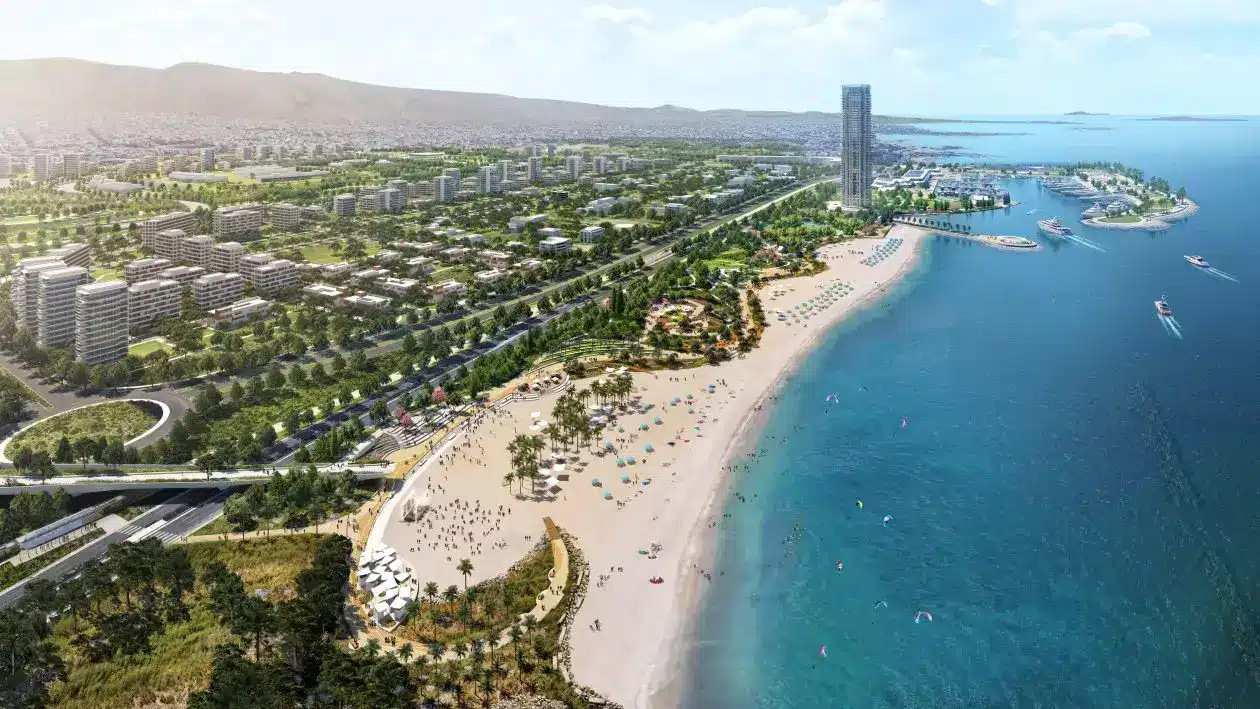
This is an €8 billion investment spanning 6,200 dunams — approximately three times the size of New York’s Central Park.
The project includes 10,000 residential units, a casino, a marina, and office towers, and is expected to create 75,000 new jobs.
The impact is already being felt. Nearby neighborhoods — Glyfada, Vari, and Vouliagmeni — have seen price increases of 20–30% since the project was announced.
With €800 million in sales in 2024, it is clear that demand remains strong.
Additional Infrastructure Projects Impacting Property Prices
Athens’ metro network continues to expand with the new Line 4, which is set to add 15 new stations by 2027.
The Port of Piraeus is receiving a €600 million investment from China’s COSCO.
At the same time, the airport is undergoing a €500 million expansion, increasing its capacity to 50 million passengers.
All of these projects create a domino effect: areas that were once overlooked are becoming increasingly attractive, driving property prices upward.
2025 Outlook: Is Now the Right Time to Invest in Greece?
After six years of accompanying investors and hundreds of completed transactions, our answer is clear: yes.
The Greek market of 2025 no longer offers annual price increases of 30% like in 2018–2019. Instead, it offers stability with reasonable growth potential.
Property prices remain 30–40% lower than in comparable European capitals, rental yields are relatively high, and demand — from both tourists and investors — continues to be strong.
Who Is This Market Suitable For?
The Greek market is particularly suitable for investors with a 5–10 year horizon, seeking net returns of 4–5% combined with moderate capital appreciation.
It is also a good fit for those interested in obtaining a Golden Visa, or for investors looking to diversify their portfolio outside Israel.
Who Is It Not Suitable For?
If you are looking to get rich quickly, or lack the patience to deal with Greek bureaucracy, this market may not be the right fit.
Likewise, if your budget is below €150,000, it can be challenging to find a high-quality property in a strong location.
Our Three Rules for Success
Location above all
A small apartment in central Athens is preferable to a villa on a remote island.
Long-term thinking
The Greek market rewards patience.
Professional guidance
Bureaucracy and language barriers make local expertise essential.
Sources & References
- Bank of Greece – Housing Price Index Reports 2023-2025
- ELSTAT (Hellenic Statistical Authority) – Building Activity Statistics 2024-2025
- Eurostat – House Price Index Q1 2024, Economic Indicators 2024
- Υπουργείο Μετανάστευσης (Ministry of Migration) – Golden Visa Statistics 2024
- ΞΕΕ (Hellenic Chamber of Hotels) – Accommodation Data 2023-2024
- Lamda Development – Hellinikon Project Financial Reports 2024
- European Commission – Recovery and Resilience Facility Greece
- Government Gazette (ΦΕΚ) – Regulatory Updates 2024-2025
- Knight Frank Greece – Real Estate Market Report 2025
- JLL Greece – Investment Market Overview 2024
Frequently Asked Questions
What Is the Real Difference Between Investing in Athens and Investing in Islands Like Crete or Rhodes?
The difference is between a stable investment and a seasonal bet.
-
In Athens, demand exists 12 months a year — driven by students, professionals, diplomats, and business tourism.
-
On the islands, around 80% of annual income is generated within just five months (May–September), leaving properties vacant during winter.
-
Maintenance costs on the islands are 30–40% higher due to humidity, salt exposure, and limited access to skilled professionals.
-
Liquidity is dramatically different — properties in Athens typically sell within 2–3 months, while sales on remote islands can take a year or more.
-
Price per square meter on popular tourist islands can be 2–3 times higher, yet net yields are often similar or even lower.
Our rule:
Island investments are suitable only for investors with at least €500,000 and a high tolerance for risk.
Learn more about island investments.
What Hidden Costs Do Investors Often Overlook?
Small costs can quickly add up to an additional 15–20% on top of the purchase price.
-
Engineer inspection: €400–600 (mandatory for properties over 30 years old)
-
Document translation & apostille: €300–500 per transaction
-
Electricity/water connection setup: €200–400 per utility
-
Initial property insurance: €500–800 per year (often 50% higher than expected)
-
International bank transfer fees: 0.5–1% of the transaction amount
-
Basic renovations: Even a “renovated” apartment typically requires €5,000–10,000 in adjustments
Our recommendation:
Plan a total budget of 110–115% of the property price, plus an additional 10% for renovations.
See a detailed cost breakdown.
Should You Invest in One Large Property or Several Smaller Ones?
The answer depends on your goals and management experience.
-
One large property (€300,000+) – Easier to manage, attracts higher-quality tenants, but carries concentrated risk
-
2–3 studio apartments (around €100,000 each) – Better risk diversification and rental flexibility, but more complex management
-
Yield perspective: Smaller studios often deliver 1–2% higher returns, with more operational effort
-
Capital appreciation: Larger properties in prime locations tend to appreciate faster
The key question:
How much time are you willing to dedicate to property management?
What Happens If the Greek Government Cancels the Golden Visa Program?
This is a common concern — and the answer is more reassuring than most expect.
-
Existing rights are protected: Investors who already received a visa can renew under the original terms
-
The property investment remains intact: The real estate market does not rely solely on Golden Visa demand
-
Only 4% of transactions in Athens involve Israeli Golden Visa investors — the market is far more diversified
-
European precedents show that full cancellations are rare; thresholds are usually raised or areas restricted
-
Alternatives exist: Digital Nomad visas and Pensioner visas also allow long-term residency
The Greek market is strong enough to withstand regulatory changes.
Get the latest Golden Visa updates.
Is It Better to Wait for Prices to Drop or Enter the Market Now?
History shows that those who wait usually lose.
-
Investors who waited in 2018, claiming prices were “too high,” missed out on a 60% increase
-
Price-supporting factors — supply shortages, booming tourism, and the Ellinikon project — are not disappearing
-
Even a 10% price correction would not offset two years of lost rental income
-
Rising interest rates may actually make future financing more difficult
-
The capital gains tax freeze expires at the end of 2025
The right approach:
If you find a quality property in a strong location at a fair price — move forward.
A moderate market is better than missed opportunities.
How Do You Find Properties Outside the Public Portals?
The best deals never make it online.
-
Approximately 70% of transactions are closed through personal connections before public listing
-
Local agents reserve their best properties for repeat clients
-
Pre-marketing purchases from developers can save 15–20%
-
Estate properties often sell 10–15% below market value due to urgency
-
Working with a local firm matters — at Beta Real Estate, we’ve built an extensive network of agents, lawyers, and developers who alert us to opportunities before they reach the open market