 Why invest in Greece
 Why invest in Athens
 FAQ
FAQ Apartment Prices in Athens: 2025 Review
 Mortgage in Greece 2025: A Comprehensive Guide to Obtaining Real Estate Financing in Greece
 Golden Visa Greece: The Complete Guide to Obtaining a Golden Visa in Greece




Greece remains one of Europe’s most compelling real estate stories in 2026, but investors are no longer looking at the market as a single opportunity. The smarter question is where to invest.
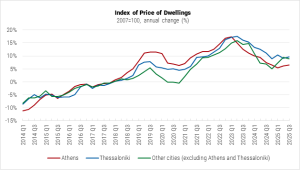
Athens continues to attract buyers looking for liquidity, year-round demand, and large-scale urban development. Thessaloniki has become more credible as an investment city now that its metro is operational and the local market is still priced below the capital. The islands, meanwhile, remain attractive for lifestyle-led and tourism-led strategies, but they also come with the highest seasonality, tighter operating considerations, and greater exposure to short-term rental rules. Recent Bank of Greece data shows that residential prices kept rising through 2026, with Athens up 6.2% for the year and Thessaloniki up 9.6%, confirming that both city markets still have momentum going into 2026.
For international investors, that means the best destination depends less on headline excitement and more on your actual strategy: stable income, capital appreciation, short-term rental upside, or a mixed-use portfolio approach.
Key Takeaways
- Athens remains the most balanced market for investors seeking stability, liquidity, and year-round rental demand.
- Thessaloniki offers lower entry prices and stronger recent price growth, making it attractive for upside-focused buyers.
- The islands can generate strong seasonal income, but they carry the highest seasonality and operational risk.
- Greece’s tourism sector remains a major tailwind for real estate, with 2024 travel receipts reaching €21.6 billion and inbound traveller flows rising 12.8% year on year.
- Short-term rental regulation is tighter in 2026 than it was a year earlier, especially from a compliance standpoint.
- Thessaloniki is no longer a “future infrastructure” story alone, because the metro is already operating and the Kalamaria extension was scheduled for the second half of 2025.
- Investors should compare destinations not only by gross yield, but also by demand consistency, exit liquidity, and regulatory exposure.
Why Greece Still Deserves Investor Attention in 2026
Greece continues to appeal to international investors because it combines relatively accessible entry pricing with strong tourism demand, improving infrastructure, and a market that still offers room for selective growth.
Tourism remains one of the clearest drivers behind the investment case. Based on final Bank of Greece data, travel receipts reached €21.59 billion in 2024, inbound traveller flows rose 12.8%, and Attica was the most visited region, while the Southern Aegean captured the largest share of total receipts and overnight stays. That matters because it supports both urban rental demand in Athens and tourism-led demand across the islands.
At the same time, the property market is still advancing. According to the Bank of Greece, apartment prices in 2025 rose by 7.8% nationwide, with Athens at 6.2% and Thessaloniki at 9.6% for the year. In other words, the market is still growing, but it is doing so in a more differentiated way, which makes location selection even more important in 2026.
Expert tip: In Greece, choosing the right micro-location often matters more than choosing the right city.
Athens: The Most Balanced Investment Destination
Athens remains the strongest all-round option for many international investors because it offers the broadest demand base. The city benefits from tourism, student demand, local professionals, digital nomads, and business travel, which helps support both long-term and short-term rental strategies.
That diversity is one of Athens’ biggest advantages. It reduces dependence on one tenant profile and makes the market more resilient during seasonal shifts. It also supports better exit liquidity than most island markets, because Athens attracts both domestic and international buyers.
From a 2026 perspective, Athens still stands out for infrastructure and market depth. Attica was the most visited region in Greece in 2024, and Athens continues to benefit from the concentration of jobs, transport links, and regeneration projects. For investors comparing destinations, that translates into more consistent occupancy potential and a broader resale market.
Popular investment zones still include Koukaki for tourism-driven demand, Zografou for student-led long-term demand, and Piraeus for investors focused on long-term transformation and connectivity. Much of that pattern is visible in where foreign investors are buying in Athens.
Expert tip: In Athens, properties near metro access usually outperform similar units in weaker transport locations, especially when targeting renters who value convenience.
Thessaloniki: Lower Entry Prices, Stronger Growth Potential
Thessaloniki is now a much more serious contender than it was a year ago. The biggest change is infrastructure credibility. The city’s metro is already operating, and the Kalamaria extension was slated to become operational in the second half of 2025, which materially strengthens the city’s accessibility story heading into 2026.
The second major point is pricing momentum. Bank of Greece data shows Thessaloniki outpaced Athens in 2025 price growth, with apartment prices rising 9.6% for the year versus 6.2% in Athens. That does not automatically make Thessaloniki the better investment, but it does support the case for investors who are willing to accept slightly less market depth in exchange for stronger upside potential.
Thessaloniki still tends to appeal to buyers looking for:
- lower entry prices than Athens
- exposure to a major Greek city with a large student population
- appreciation potential linked to infrastructure and urban improvement
- a market that is less saturated than parts of central Athens
Areas such as Ano Poli, Ladadika, and Vardaris can still be attractive, but selection matters. Thessaloniki is not as forgiving as Athens if the property is in the wrong pocket of the city or depends too heavily on one rental segment.
Expert tip: Thessaloniki often works best for investors prioritizing capital appreciation over maximum short-term liquidity.
The Greek Islands: High Seasonal Upside, Higher Volatility
The islands remain highly attractive, but they are best approached with realistic expectations. A well-located island property can perform very well during the tourist season, especially in established markets such as Santorini, Mykonos, Crete, Rhodes, Corfu, Paros, or Naxos. But the islands are not a single market, and seasonality remains the defining investment issue.
That is even more important in 2026 because Greece has moved toward tighter short-term rental oversight. The AADE short-term rental registry remains a core requirement, with filing deadlines and registry finalization rules clearly set out by the tax authority, while the Ministry of Tourism’s new framework took effect on 1 October 2025, adding stricter standards to the sector.
For investors, this means island property can still be highly profitable, but the strategy must be more disciplined. You need to assess:
- how long the real operating season is on that specific island
- whether demand is luxury-led, family-led, or broad-market tourism
- maintenance costs tied to humidity, sea air, and distance from contractors
- how dependent the property is on short-term rental licensing and platform-based demand
For investors considering a lifestyle-plus-income strategy, island assets may still make excellent sense. But for purely passive investing, they are usually more management-intensive than city properties.
Expert tip: On the islands, gross summer income can look impressive, but annual net yield is what decides whether the investment truly works.
2026 Comparison: Which Market Fits Which Investor?
Athens
Athens is generally the best fit for investors seeking a balanced profile.
It offers:
- strong year-round rental demand
- the deepest resale market in Greece
- broad tenant diversity
- strong transport infrastructure
- a better balance between income and liquidity
Athens is usually the safest choice for investors who want a combination of rental income, appreciation potential, and smoother asset management. Its wider appeal is part of why Athens remains a leading destination for real estate investment.
Thessaloniki
Thessaloniki is often the better fit for investors seeking stronger upside and lower entry costs.
It offers:
- better affordability than Athens
- strong recent price momentum
- improving infrastructure
- a large student and local renter base
It is especially attractive for buyers who are comfortable with a market that is smaller and somewhat less liquid than Athens, but potentially more dynamic at this stage of the cycle.
The Islands
The islands are best for investors prioritizing tourism-led returns or a lifestyle component.
They offer:
- potentially strong short-term seasonal income
- high emotional and lifestyle appeal
- strong performance on select islands with international demand
But they also come with:
- more seasonality
- more operating complexity
- stricter compliance risk for short-term rental models
- less predictable winter income
What Has Actually Changed Since the 2025 Version of This Analysis?
The biggest 2026 updates are practical, not cosmetic.
First, Thessaloniki should no longer be described mainly as a market waiting for its metro. It has already crossed that threshold, and that changes how investors should evaluate accessibility and neighborhood potential.
Second, short-term rentals now deserve more weight in the investment decision. Greece’s Ministry of Tourism implemented a new legal framework from 1 October 2025, and AADE continues to require proper registry compliance and filing discipline. That does not eliminate the short-term rental opportunity, but it does make professional execution more important.
Third, the latest full-year property data available at the time of writing is for 2025, and it shows continued price growth in both Athens and Thessaloniki. So while the 2026 investment case remains strong, it is no longer a story of post-crisis bargain hunting alone. It is increasingly a story of selective buying, neighborhood quality, operational discipline, and timing.
The wider backdrop is also clearer when viewed alongside Greece’s real estate market and economy, where growth is increasingly differentiated by sector and location.
Final Thoughts
In 2026, Athens still stands out as the most complete real estate investment destination in Greece. It offers the best combination of demand consistency, infrastructure, liquidity, and strategic flexibility.
Thessaloniki is more convincing than ever and deserves serious attention from investors who want stronger upside and lower entry prices. The islands remain compelling, but only when approached with a clear understanding of seasonality, compliance, and operating intensity.
For most international investors, the decision should come down to investment style. If your priority is stability and year-round performance, Athens still leads. If you want appreciation potential at a lower entry point, Thessaloniki has become far more attractive. If you want a tourism-led asset with lifestyle appeal, the islands can work very well, but they require the most careful planning.
Ready to Explore Opportunities in Greece?
Whether you are comparing Athens, Thessaloniki, or the islands, the best investment decision starts with a clear strategy, realistic numbers, and the right local guidance.
Beta Real Estate works with international investors looking to identify the right market, the right neighborhood, and the right property for their goals. From location analysis to acquisition support and investment planning, our team can help you evaluate opportunities with clarity and confidence.
FAQ – Common Questions About Investing in Athens, Thessaloniki, and the Greek Islands
Which Greek destination is best for a first-time foreign investor?
Athens is usually the safest starting point.
- It offers year-round demand rather than heavy seasonal swings.
- The market is broader and more liquid than most island markets.
- It is easier to build a stable long-term strategy there.
- Exit options are generally stronger than in smaller markets.
Expert tip: First-time investors usually benefit more from market depth and predictability than from chasing the highest possible seasonal yield.
For further reading, see Why Invest in Athens? – A Smart Real Estate Opportunity.
Is Thessaloniki now a stronger investment option in 2026?
Yes, much more than before.
- The city now has an operating metro, which improves accessibility and investor confidence.
- Apartment prices in Thessaloniki rose faster than in Athens in 2025, according to the Bank of Greece.
- Entry prices are still typically lower than in the capital.
- It can suit buyers who want growth potential over immediate market depth.
Expert tip: Thessaloniki works best when you buy with a medium-term view, not just for immediate cash flow.
For further reading, see Residential Property Prices and Yields in Greece – 2025.
Are the Greek islands still worth it for rental income?
Yes, but only with a realistic operating plan.
- Seasonal income can be strong on the right island.
- Winter demand is often much weaker than summer demand.
- Maintenance and management tend to be more demanding.
- Regulatory compliance matters more in 2026 than it did previously.
Expert tip: Always underwrite an island property based on annual occupancy, not just peak-season nightly rates.
For further reading, see Buying a Holiday Home and Seaside Properties in Greece: Everything You Need to Know.
How important are short-term rental regulations in 2026?
They are now a central part of investment planning.
- Greece’s updated framework for short-term rentals took effect on 1 October 2025.
- Properties still need to comply with registry and reporting requirements through AADE.
- Compliance risk is especially important in tourism-heavy areas.
- Investors should verify the operating model before they buy, not after.
Expert tip: A property with great location potential is not a great investment if the rental model is weakly structured from a compliance perspective.
For further reading, see A Complete Guide to Short-Term Rental (Airbnb) Investments in Athens – 2026.
Does Athens still offer growth potential, or is it mainly a stability play now?
It offers both, but the profile is more balanced than aggressive.
- Athens continues to benefit from tourism, transport links, and urban regeneration.
- Bank of Greece data shows prices still rose in 2025, even if Thessaloniki grew faster.
- The city remains attractive for both rental demand and resale liquidity.
- It is usually the strongest choice for investors seeking a blend of income and long-term value.
Expert tip: In Athens, the right neighborhood can still materially outperform the wider city average.
For further reading, see Where to Invest in Athens: Neighborhoods That Deliver Real Returns.