 Why invest in Greece
 Why invest in Athens
 FAQ
FAQ Apartment Prices in Athens: 2025 Review
 Mortgage in Greece 2025: A Comprehensive Guide to Obtaining Real Estate Financing in Greece
 Golden Visa Greece: The Complete Guide to Obtaining a Golden Visa in Greece



For international investors evaluating Greek real estate, one of the first questions is always the same: what level of income can a residential property in Greece realistically generate?
It is an important starting point, but the answer is more nuanced than a single yield figure. In practice, returns in Greece depend on a combination of factors, including acquisition timing, location, tenant demand, tax exposure, asset quality, and the rental strategy behind the investment. The strongest-performing properties are not always those with the highest headline yield. More often, they are the assets that combine dependable rental income with long-term capital appreciation.
In 2026, the Greek residential market continues to grow, but it is no longer driven only by the broad post-recovery momentum of previous years. Prices are still increasing, demand remains resilient, and foreign capital continues to support the market. At the same time, the environment has become more selective and more disciplined. For investors, that is often a positive sign: execution matters more, and fundamentals matter more.
Key Takeaways
- Greek residential property prices are still rising in 2026, although growth is more moderate than during the earlier rebound years.
- New-build apartments continue to outperform older stock, reflecting strong demand for modern, low-maintenance assets.
- Athens remains the most balanced market for international investors, offering liquidity, year-round demand, and stronger operational support.
- Thessaloniki and selected regional cities can offer faster growth from lower entry points, but they may come with thinner resale liquidity.
- Gross residential yields in Greece often range from about 5.5% to 7.5%, while net yields are typically lower after taxes, maintenance, and management costs.
- Long-term rentals usually provide more stability, while short-term rentals can deliver stronger income with higher operational and regulatory risk.
- Successful investing in Greece now depends less on broad market momentum and more on neighborhood selection, rental strategy, and disciplined underwriting.
A Market That Is Still Growing, but More Selectively
After several years of strong upward movement, Greece’s residential market entered 2026 in a more mature phase. Apartment prices across the country have continued to rise, generally by around 5% to 8%, depending on the city, micro-location, and condition of the property.
This moderation should not be viewed as weakness. In many markets, slower and steadier growth improves investability. When prices rise too quickly, speculation tends to dominate decision-making. When growth becomes more measured, investors are better able to evaluate opportunities based on demand depth, neighborhood quality, tenant profile, and long-term resale potential.
Athens still offers the broadest range of opportunities, from affordable apartments in emerging districts to higher-value properties in established central neighborhoods. Thessaloniki remains attractive for investors pursuing stronger recent growth, while regional cities such as Patras, Larissa, and Volos are drawing more attention from buyers seeking lower acquisition costs and solid rental demand.
Expert tip: In a maturing market, the best opportunities usually come from choosing the right micro-location rather than simply choosing the city with the strongest recent price growth.
Average Prices Across Greece’s Main Residential Markets
For a typical 70 sqm apartment, pricing varies significantly by city, neighborhood, and asset quality.
In Athens, acquisition prices generally range from around €100,000 to €250,000, with prime central districts sitting at the top end of the range. Rental demand in the capital is often strongest in neighborhoods with year-round occupancy drivers and good transport access. Current apartment prices in Athens remain a useful benchmark when comparing neighborhoods and investment strategies.
In Thessaloniki, similar apartments often trade in the range of €90,000 to €150,000. The city benefits from a younger population profile, university demand, and ongoing urban renewal, all of which support rental performance.
In Piraeus and other major urban centers, purchase prices often fall between €70,000 and €120,000. Piraeus remains especially interesting because of its infrastructure improvements and its long-term connection to port activity and logistics.
Regional cities can offer entry prices comparable to outer Athens districts, but they come with a different risk-reward profile. The lower acquisition cost may be attractive, but resale liquidity and the local professional ecosystem are not always as developed.
Island markets operate on a different level altogether. In destinations such as Santorini, Mykonos, and Corfu, prices can exceed €5,000 per sqm, and rental income potential can be stronger. However, those markets also come with greater seasonality, more operational intensity, and higher management costs.
Expert tip: A lower entry price does not automatically mean a better investment. Liquidity, tenant depth, and exit flexibility are just as important as the purchase number.
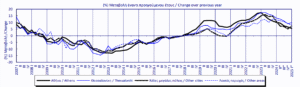
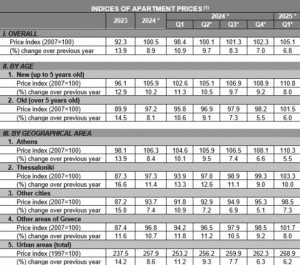
Apartment Rental Yields in Greece – Source: Bank of Greece
Long-Term vs Short-Term Rentals
One of the most important strategic decisions in Greece is the rental model.
Long-term rentals generally offer lower headline returns, but they provide more predictable occupancy, steadier cash flow, and far less day-to-day involvement. In neighborhoods with strong student, professional, or family demand, this can be a highly efficient strategy for investors seeking consistency.
Short-term rentals can produce stronger income, particularly in high-tourism areas. But they require active management. Guest communication, cleaning, pricing, marketing, and occupancy optimization all directly influence performance. Competition is higher, and regulation is becoming increasingly important.
As a broad rule, long-term rentals often generate gross yields of around 5% to 6%, with net yields closer to 3.5% to 5%. Short-term rentals may deliver gross yields in the 6.5% to 9% range, with net yields often around 4.5% to 6.5%, assuming strong occupancy and professional execution.
For investors focused on stability and simplicity, long-term leasing usually remains the more sustainable route. For those willing to operate more actively and accept greater regulatory exposure, short-term rentals can still deliver higher income.
Expert tip: If a short-term rental only works under perfect occupancy assumptions, it is usually too aggressive as an investment case.
Q1 2026 Snapshot: What the Market Is Showing
The latest market snapshot suggests that Greek housing is still expanding, but with a more measured pace than during the earlier rebound period.
Apartment prices across Greece increased by 6.8% year over year in 2025. New apartments, typically defined as properties up to five years old, rose by 8.0%, while older apartments increased by 6.0%. This reinforces a clear trend: buyers continue to pay a premium for newer stock with lower renovation requirements.
The regional breakdown also matters. Athens recorded annual growth of 5.5%, Thessaloniki reached 10.0%, other cities rose by 7.3%, and peripheral regions increased by 8.0%.
These remain strong figures, even if they show moderation from earlier years. In 2024, prices rose by 8.9%, and in 2023 they climbed by 13.9%. The shift suggests a market transitioning from rapid recovery to a more balanced and sustainable growth cycle.
Expert tip: Stronger numbers in secondary markets can be appealing, but investors should always ask whether the local rental depth and exit market are equally strong.
Regional Differences Matter More Than Ever
Greece should not be treated as a single investment market. It is a network of local markets with very different drivers.
Athens remains the most stable and operationally accessible option for many international investors. Thessaloniki may offer faster recent growth, supported by urban regeneration and student demand. Smaller cities such as Patras, Larissa, and Volos may present attractive rental economics at lower entry points, but they often come with thinner resale liquidity and a smaller professional support ecosystem.
Tourist islands are a separate niche. They can offer strong upside and premium nightly rates, but investors need to be realistic about seasonality, local regulation, and maintenance intensity. In these markets, success depends less on general residential momentum and more on selecting the right asset in the right micro-location.
Expert tip: The more specialized the market, the less room there is for buying the wrong property.
What Drives Price per Square Meter?
In Greece, price per sqm is influenced by much more than the city name alone.
Transport access is a major value driver. Properties near metro stations or strong public transport links tend to attract both tenants and buyers more easily.
Condition also matters. Newly built or recently renovated apartments typically command a premium because they reduce near-term capital expenditure and are easier to lease.
Proximity to universities, tourist zones, and mixed-use urban districts can significantly improve occupancy and rental potential. In some neighborhoods, public and private regeneration projects can also create stronger medium-term upside.
For value-add investors, renovation can still be an effective strategy. A well-selected property acquired below its full potential and upgraded properly can improve both rental performance and resale value within a relatively short period.
Expert tip: In urban Greece, transport connectivity often has a direct effect on both occupancy rates and resale demand.
Outlook Through 2029
The medium-term outlook remains constructive. According to the source material, the Greek real estate market is expected to grow at an average annual rate of around 3.2% through 2029.
That is not the profile of a speculative boom. It is the profile of a market that may continue appreciating steadily as it becomes more institutional, more internationally visible, and more attractive to professional investors.
There are still constraints. New-build supply remains limited in many locations. Infrastructure quality varies by city. Regulation around short-term rentals is likely to tighten further. Even so, Greece continues to stand out within the eurozone as a market that combines accessible entry prices, strong lifestyle appeal, and durable demand fundamentals.
Expert tip: A market with moderate, sustainable growth can be more attractive over the long term than one driven by short-lived speculation.
Financing, Regulation, and Tax Considerations
Financing is available in Greece for foreign buyers, although the process is often more bureaucratic than many investors expect. Interest rates, equity requirements, and documentation standards all make mortgages in Greece more demanding than many international buyers initially expect.
Transfer tax remains one of Greece’s practical advantages. The standard rate is approximately 3.09%, which is relatively competitive by international standards. The source material also notes that capital gains tax had been frozen until the end of 2025.
Rental income taxation depends on both Greek law and the investor’s home-country framework, including any applicable double tax treaty with Greece. For that reason, tax planning should be part of the acquisition process from the beginning, not something addressed only after closing.
Regulation is also becoming increasingly relevant, especially for short-term rentals in tourism-heavy districts. Additional restrictions over the coming years remain a realistic possibility, so investors should build strategies that remain viable even under tighter rules.
Expert tip: The best investment plan is one that still works after financing friction, tax leakage, and regulatory changes are built into the numbers.
Final Thoughts
Greece remains one of Europe’s most compelling residential property markets for international investors, but the opportunity in 2026 is more selective than it was during the earlier rebound phase.
That is ultimately a positive development. Prices are still rising, but at a healthier pace. Rental demand remains strong. Athens continues to offer one of the best combinations of liquidity, stability, and income potential in the region, while Thessaloniki and selected regional cities create additional opportunities for growth-oriented investors.
The real advantage now lies in execution: choosing the right neighborhood, selecting the right rental model, understanding tax and regulatory exposure, and underwriting returns over a multi-year horizon rather than chasing short-term momentum.
Ready to Explore Property Investment Opportunities in Greece?
If you are considering residential real estate in Greece, Beta Real Estate can help you assess the market with a clear investment lens.
Our team works with international investors looking for the right balance of rental income, long-term appreciation, location strategy, and risk management. From identifying the right asset to evaluating yield potential and navigating the buying process, we help investors make informed decisions with greater confidence.
Contact Beta Real Estate to explore opportunities in Athens and across Greece with local insight and investor-focused guidance.
FAQ – Common Questions About Residential Property Prices and Yields in Greece
Is Greek residential property still profitable for foreign investors in 2026?
Yes, but profitability now depends more on execution than on broad market momentum.
- Yields in Greece remain attractive compared with many other European markets.
- The strongest results usually come from choosing the right location and rental model.
- Net performance depends heavily on taxes, maintenance, management, and vacancy.
- Investors should focus on long-term fundamentals rather than headline return projections.
Expert tip: In a more mature market, disciplined underwriting matters more than chasing the highest advertised yield.
For further reading, see Residential Property Prices and Yields in Greece – 2026.
What net yield is realistic in Greece?
In many cases, a realistic net yield is around 3.5% to 5%, depending on the property and strategy.
- Gross yields may look significantly higher in marketing materials.
- Operating costs can materially reduce final returns.
- Long-term rentals usually offer lower gross income but more stability.
- Short-term rentals may offer higher net returns only with strong execution.
Expert tip: Always stress-test your assumptions for occupancy, maintenance, and taxes before finalizing a purchase.
For further reading, see How Much Can You Earn from Rental Income in Athens?.
Is Athens or Thessaloniki the better choice?
Athens is usually the more balanced option, while Thessaloniki may appeal more to growth-focused investors.
- Athens offers deeper liquidity and broader year-round demand.
- Thessaloniki can provide lower entry prices and stronger recent growth.
- Athens generally has a more developed property-management and resale ecosystem.
- The better choice depends on whether the investor prioritizes stability or growth potential.
Expert tip: The best city is not always the one with the fastest growth rate, but the one that best fits your investment strategy and risk tolerance.
For further reading, see Real Estate Investments in Greece in 2026: Athens, Thessaloniki or the Islands?.
Are short-term rentals still worth considering?
Yes, but they should be approached as an operating business rather than a passive investment.
- They can generate higher income in strong tourism markets.
- They require more active management and more frequent operational decisions.
- Regulation is becoming increasingly relevant in some areas.
- Seasonality can create wider fluctuations in occupancy and cash flow.
Expert tip: A short-term rental strategy should be based on conservative occupancy assumptions, not peak-season projections alone.
For further reading, see A Complete Guide to Short-Term Rental (Airbnb) Investments in Athens – 2026.
Can foreign buyers get financing in Greece?
Yes, although the process is typically documentation-heavy and requires meaningful equity.
- Greek banks may lend to non-resident buyers under the right conditions.
- Approval usually depends on clear documentation and financial strength.
- Bureaucracy can make the process slower than many foreign investors expect.
- Working with experienced local professionals can make financing smoother.
Expert tip: Financing should be explored early in the process, because the final structure can affect both your purchasing power and your timeline.
For further reading, see Mortgages in Greece 2026: A Comprehensive Guide to Real-Estate Financing.
What is the main investment risk in Greek residential property?
The biggest risk is often poor asset selection rather than the market itself.
- Buying in the wrong neighborhood can weaken both rental demand and resale potential.
- Overestimating short-term rental income can distort returns.
- Regulatory changes can affect certain business models more than others.
- Weak due diligence can turn a promising purchase into an underperforming investment.
Expert tip: Most disappointing outcomes begin with a weak acquisition decision, not with the wider market.
For further reading, see 8 Common Real Estate Investment Mistakes in Greece — and How to Avoid Them (2026).
Is Greece suitable for first-time international property investors?
Yes, especially when the investment is supported by strong legal, tax, and property-management guidance.
- Greece remains relatively accessible compared with many other European markets.
- Athens is often the easiest entry point because of its liquidity and year-round demand.
- A good local team can reduce friction throughout the purchase and management process.
- First-time investors should prioritize clarity, simplicity, and proven demand over aggressive yield targets.
Expert tip: For a first investment in Greece, it is often wiser to choose an easier-to-manage asset in a proven location than a more complex deal with higher projected returns.
For further reading, see The Complete Guide to Buying an Apartment in Greece: Everything You Need to Know [2026].